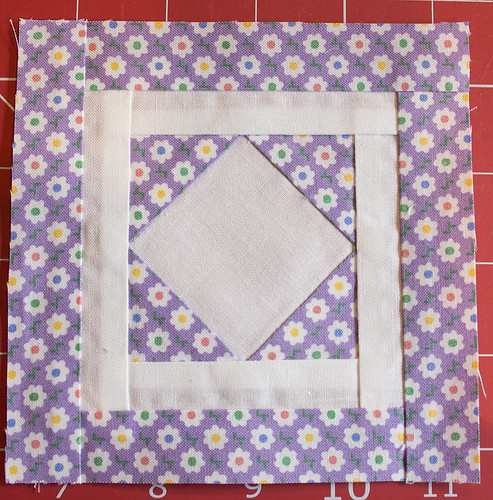
At first I thought this one was going to be REALLY quick. Well, as quick as foundation piecing can be, anyway.
Then I realized I had directional fabric to deal with and, trust me, if you don't get it to line up at least a little, your block will look really wonky.
Thanks to freezer paper foundation piecing however, it was fairly simple to do.
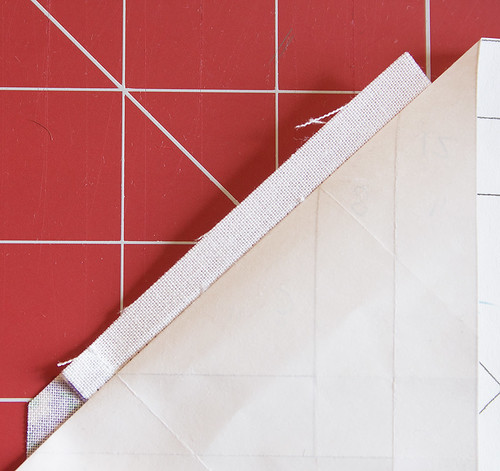
Firstly, it's important to trim your previous seam allowance to exactly 1/4". Straight.
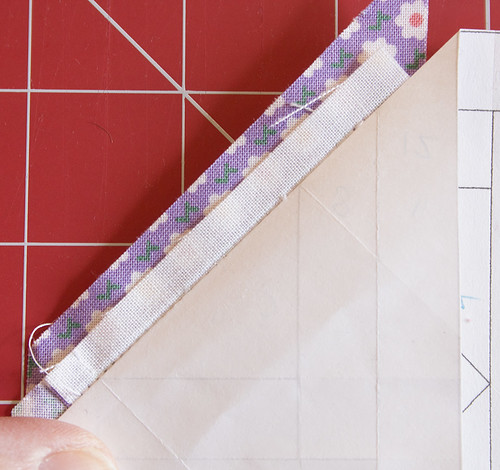
That makes it easy to line up your directional fabric along the edge.
If you line it up exactly the same way along each edge, they should all look the same at the end. Of course the little triangles are cut on the bias, so the fabric stretched a little but hey, good enough!
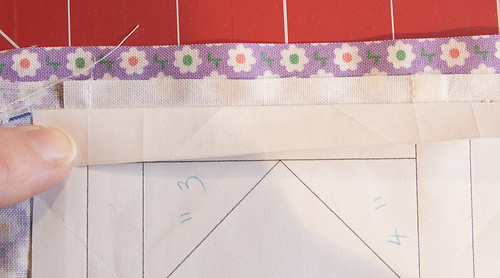
I did the same thing along the outside sections.
(Still awaiting a couple more shared blocks on Instagram (#thatquiltjanealong), Facebook, or Flickr.)
Showing posts with label C-1. Show all posts
Thursday, February 25, 2016
Wednesday, January 21, 2009
C-1
This is a very, very simple foundation pieced block. It can also be rotary cut, but I find foundation piecing to be much more accurate.
My numbering was as follows. I forgot to mirror the pattern but, since it's basically a log cabin, I figured it wouldn't matter enough to start over.

Use your favorite foundation piecing method to piece the block.
Tip: If you have plaid or striped fabric and want to keep the lines straight, three things are important. First, cut your fabric in straight strips with your rotary cutter. Second, make sure that you trim the seams evenly after each step and line the next piece of fabric up along the straight edge carefully. And, third, make sure your stitching is straight.
My numbering was as follows. I forgot to mirror the pattern but, since it's basically a log cabin, I figured it wouldn't matter enough to start over.

Use your favorite foundation piecing method to piece the block.
Tip: If you have plaid or striped fabric and want to keep the lines straight, three things are important. First, cut your fabric in straight strips with your rotary cutter. Second, make sure that you trim the seams evenly after each step and line the next piece of fabric up along the straight edge carefully. And, third, make sure your stitching is straight.
Subscribe to:
Posts (Atom)